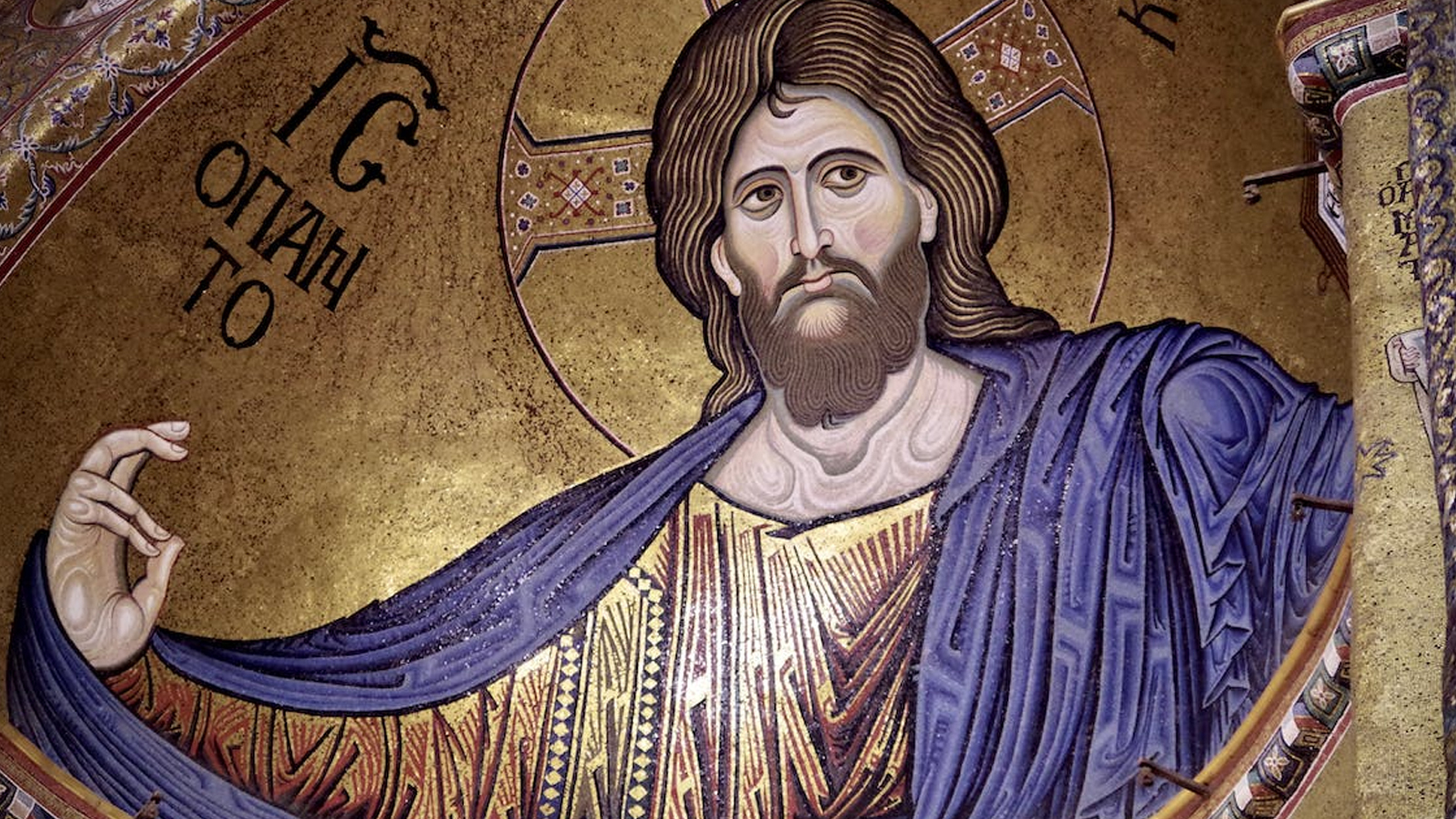
What Does God Look Like?
We simply do not know. He is The indescribable. The illustrations of Jesus (The Word incarnate) in the various artistic style of the cultures that converted to Christianity are only illustrations of, put simply, The Word incarnate. They do not show The Word; they show The Word incarnate. And the difference in the incarnate here means that the appearance of Jesus was the human body He took, His flesh, His person, the human nature that united with the divine nature without mixture, without confusion, and without change. “The Word became flesh and dwelt among us.” (John 1:14).
So, All Illustrations of God are Wrong?
No. They’re a way of connecting us with God. It’s a result of the human condition that we need something physical, something seen, to connect with. And these illustrations give us a way of seeing the unseen, being with the omnipresent. And this has been done through The Word incarnate, through Jesus and our depictions of him.
It is noteworthy to mention that the different depictions are not wrong because of their differences, but the opposite. These differences (e.g., illustrating Jesus as black in the African churches or Asian in the churches of Asia) are a way of showing that, although Jesus was—incarnate as—a Mideastern Jew, he is The Son of Man; he is all of the ethnicity and races in his infinite nature. God came to call all. “There is neither Jew nor Greek, there is neither slave nor free, there is neither male nor female; for you are all one in Christ Jesus.” (Galatians 3:28).
Moreover, God is not male nor female; He is sexless, as He isn’t confined by our human nature and these human concepts don’t apply to Him. The only reason we say “He” is to make it easier in writing implicit sentences without having to say “God” all the time. (And it’s not sexist: etymologically, the word man used to mean human before it was appropriated to meaning male. And it’s still used out of tradition. The usage of “He” is similar in that sense and is more or less fitting since Jesus was a man.)
But, Could God Have A “Shape”?
Definitely Not. Why? Well, because shapes are defined volumes in space that change over the change of time. And this contradicts God’s immutability. We can think of God as a constant, a constant across the spacetime continuum. Let’s take each component of space and time separately.
Let’s look at space first. God fills all space, all of the three dimensions. Not just fills it but overflows it into the higher dimensions. He isn’t bound by space. He is omnipresent: He’s present at every point across all dimensions that are possible by topological mathematics (which might be more than we’ve discovered/proved so far). But also, He is present at the dimensions that don’t even “exist” if you would allow that thinking: He not only fills the existent, but also, the—or at least what appears so to us—non-existent!
Now, this funny thing we call time is directly tied to His omniscience ([[On God’s Omniscience]]), as time is a critical component of knowledge. Time is a component of the universe, and God, in His overflowing omnipresent character, fills the timeline just like He does the other space dimensions. He is at every point in time all at once. Not was, but is (present tense): He is always present at all times. On top of that, He overflows out of it, as with space; He isn’t bound by linear time but is outside it (and inside it).
The parallels are clear as we are using the physics definition of treating time as a dimension just like space. We can also say that He fills, with his infinity, the non-existent dimension that we haven’t discovered yet; or a better wording might be: the component/characteristic of our universe other than the spacetime continuum we’re familiar with. He fills “empty space” and what is outside “time.” He is present everywhere all the time in every possible sense.